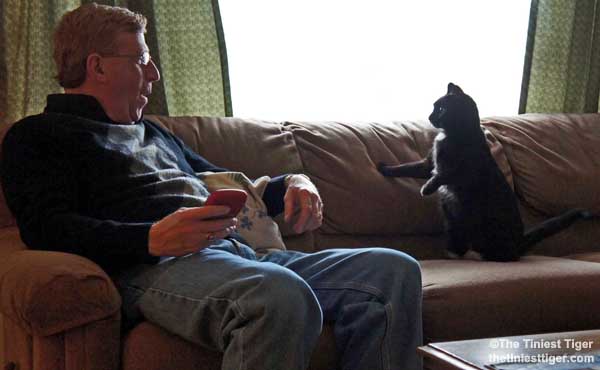
What a new study reveals about feline greetings
Do you think cats talk more to men than to women? If you’ve even walked in the door and noticed your cat more talkative around one person than another, you’re not alone and now science offers a possible explanation.
What the Research Found About Cat Greetings
In a recent study published in the scientific journal Ethology, researchers from Bilkent University ad Ankara University in Turkey set out to explore how domestic cats greet their guardians after being apart. The study asked 31 cat guardians to wear small cameras that recorded the first 100 seconds of interaction when they returned home, behaving as naturally as possible.
The researchers then analyzed 22 different feline behaviors-from tail-raising and rubbing to yawning and vocalizations to see what patterns emerged. One finding stood out clearly:
Cats vocalized significantly more- more meows, purrs, and chirps- when greeting male caregivers than when greeting female caregivers.
On average, cats produced roughly 4.3 vocalizations in the first 100 seconds with men, compared to about 1.8 with women. More than double.
This pattern held true regardless of the cat’s breed, sex, age, or the number of cats in the household.

What Might Be the Reason Cats Vocalize More To Men After Being Apart?
The researchers propose a practical explanation: female caregivers tend to talk more to and interact more frequently with their cats outside of these greeting moments. That means cat may not need to “sound the alarm” as much to get attention from women.
In contrast, men may talk less or be less responsive to subtle feline cues overall, so cats compensate by using more and louder vocalizations to get noticed.
In other words, cat might be strategically adjusting their communication not because they prefer one gender, but because they’ve learned to use the signals that work best with each individual person.
Communication, Not Preference
It’s important to clarify that this study doesn’t mean cats like men less or that they have an inherent gender preference. Instead, it suggests that:
- Cats adapt how they communicate ased on what works with differnet humans.
- Vocalizations, including meows, purrs, chirps, are tools cats use to elicit interactions, not just random noice.
- Behavioral flexibility is part of cats’ social intelligence, they’re not passive observers but active participants in human social environments.
A Note on Limitations
Like many animal behavior studies, this one has some limits worth noting:
- The sample was relatively small (31 households), and all participants were in one country (Turkey).
- Cultural norms around how men and women interact with pets may vary widely.
- The researchers didn’t control for every possible factor, such as how long the person was gone beforehand or the cat’s hunger level, which could also influence greeting behavior.
So while the findings are compelling, future research across diverse populations and cultures will help pain a fuller picture.
What This Means for Cat Lovers
Whether you’re a cat guardian or just a feline fan, this study highlights something many of have felt in our bones.
Cats are smart communicators. They watch us, adjust to us, and tailor their behavior to get what they need, whether it’s food, affection or a well-timed head scratch.
Next time your cat greets someone with a little extra vocal enthusiasm, take it as a complement. They’re paying attention and trying to connet