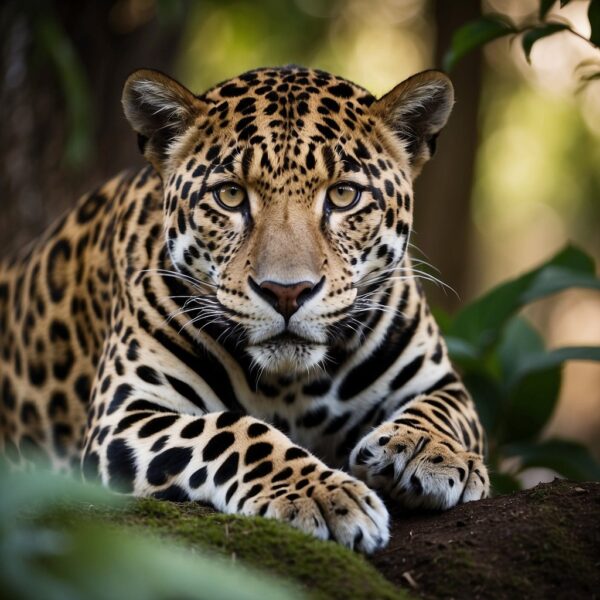
Wild Jaguars recorded meowing for the first time
Jaguars meowing? If you’ve ever shared your home with a cat, you know the sound well. That short, sharp meow—used to get your attention, ask for food, or simply say “I’m here.” For decades, scientists believed this type of vocalization was almost exclusive to domestic cats.
But now, something remarkable has happened in the wild.
For the first time ever, researchers have recorded wild jaguars producing meow-like vocalizations, and the discovery is reshaping what we thought we knew about big cat communication.
A First-of-Its-Kind Discovery in Brazil’s Atlantic Forest
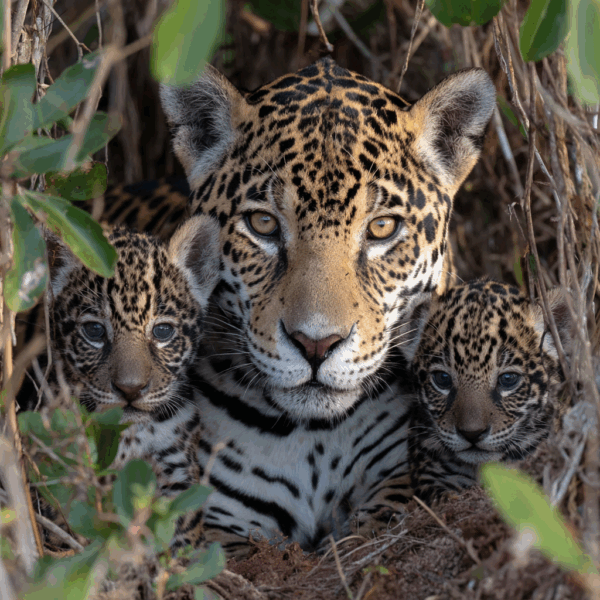
The findings come from a newly published study in the scientific journal Behaviour, documenting meow-like calls made by female jaguars and their cubs in Brazil’s Iguaçu National Park, located in the Atlantic Forest.
Using long-term camera trap monitoring, researchers captured both audio and video evidence of these sounds—an unprecedented moment in jaguar research.
The international research team included experts from:
- University of Salford (UK)
- Atlantic Technological University (Ireland)
- WWF Brazil
- The Iguaçu Jaguars Project
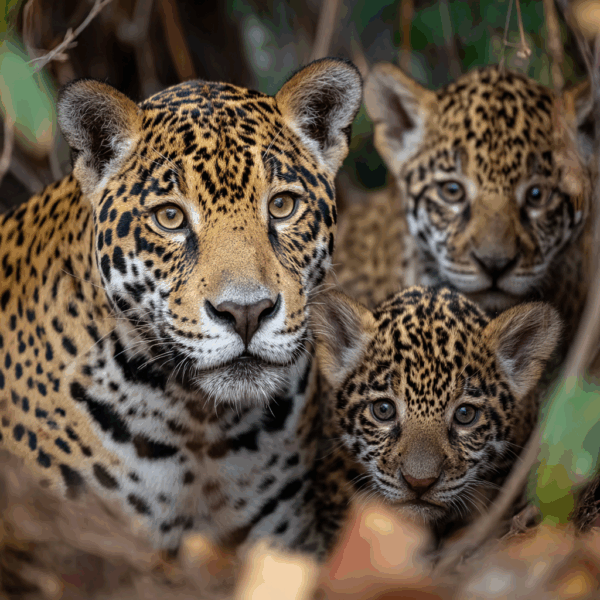
By placing monitoring cameras throughout the park, the team recorded two different female jaguars producing these unusual calls, along with cubs responding vocally to their mothers.
What Did the Jaguars meowing Sound Like?
The recorded calls were described as:
- Sharp and brief
- High-pitched
- Repeated in short sequences
Because of their pitch, duration, and rhythm, the sounds closely resemble the meows produced by domestic cats.
In the recordings, female jaguars appeared to be calling their cubs, who responded with similar meow-like sounds—suggesting the vocalization plays a role in mother-young communication, likely helping them locate one another in dense forest environments.
Why This Jaguar vocalization Was So Surprising
Most people associate big cats with roars, growls, chuffs, or snarls—not meows. In fact, many large cats such as lions and tigers cannot meow at all, due to the structure of their larynx and trachea.
That’s what makes this discovery so fascinating.
While meowing has been observed in some captive wild cats, it is typically:
- Used by both males and females
- Repetitive and loud
- Employed for long-distance communication, territorial signaling, or attracting mates
Seeing meow-like calls used naturally by wild jaguars, especially in a maternal context, was entirely unexpected.
What This Tells Us About Big Cat Communication
The findings highlight something scientists are increasingly discovering across animal behavior research: communication systems are far more complex and flexible than we once believed.
The researchers suggest that jaguars may use these meow-like sounds primarily to help mothers and cubs stay in contact—but they don’t rule out other possibilities, such as communication related to reproduction or social interaction.
Dr. Marina Duarte, Research Fellow at the University of Salford, explained:
“As far as we know this is the first time that jaguars have been recorded using this kind of communication, which we are incredibly excited about.
This research really deepens our knowledge of how big cats can communicate. We think they are making these sounds to help locate their young, but they could also be using them for reproductive purposes too, to find a mate perhaps. It does sound very cute to our ears!”
How This Compares to Domestic Cats
Interestingly, adult domestic cats rarely meow at each other. Instead, meowing is a behavior kittens use to communicate with their mother—and one that adult cats primarily reserve for humans.
Many scientists believe cats learn that humans respond to meows, which is why your cat may have a wide vocabulary of sounds just for you.
That makes the jaguar discovery even more intriguing: it suggests that meow-like vocalizations may have deeper evolutionary roots, especially in maternal communication, than previously assumed.
Why Long-Term Monitoring Matters
This breakthrough wouldn’t have been possible without sustained conservation and monitoring efforts.
Vania Foster, Head of Research for the Jaguars of Iguaçu Project, emphasized the importance of long-term observation:
“These results highlight the value of long-term monitoring efforts for this iconic Atlantic Forest species and show that there is still much to learn about how jaguars interact and communicate in their natural environment.”
In other words, even with one of the world’s most studied big cats, nature still has surprises waiting to be heard.
A Gentle Reminder of How Much We Still Don’t Know
From the quiet meow of a house cat to the unexpected calls of a jaguar in the forest, this discovery reminds us that animal communication is nuanced, adaptive, and still largely mysterious.
And sometimes, the wild sounds a little more familiar than we ever imagined.
Source
Foster, V., Duarte, M., Gomes, P., Reginato, T., Kotz, A., Nascimento, V., … & Barros, Y. (2025). Unusual jaguar vocalizations: first recorded meowing in females associated with maternal behaviour in southeastern Brazil. Behaviour, 162(15), 1109-1120.