The Cameras Kept Watching: Chernobyl Exclusion Zone
When Russian forces entered Ukraine’s Chornobyl Exclusion Zone on February 24, 2022, scientists could no longer safely enter the region. But hidden throughout the forests and abandoned landscapes, their wildlife cameras kept watching.
The motion-activated cameras continued recording as military convoys moved through the exclusion zone, artillery sounded, fires burned and Russian troops occupied the area for 36 days.
What the cameras captured offered scientists something exceedingly rare: a real-time record of how wild animals altered their behavior during an active military conflict.
The results, published in the journal Science, show that war disrupted the daily lives of several mammal species. Red deer, roe deer, red foxes and wild boar all changed their activity patterns—but not always in the ways researchers expected.
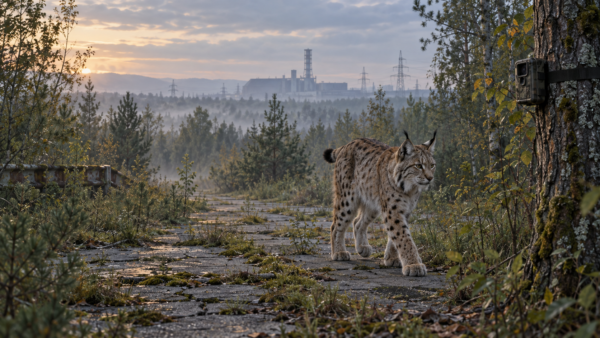
And amid these changes, the Eurasian lynx presented an intriguing contrast.
Cameras Intended to Study Lynx Recorded a War
The camera traps had not been installed to study warfare. Beginning in 2021, researchers placed cameras across the Ukrainian portion of the Chernobyl Exclusion Zone to monitor Eurasian lynx and other wildlife.
The exclusion zone covers approximately 1,000 square miles surrounding the site of the 1986 Chernobyl nuclear disaster. Once heavily populated, much of the landscape was abandoned after radioactive contamination forced people to leave.
In the decades that followed, forests reclaimed villages, roads and farmland. With human activity severely restricted, wildlife returned.
Lynx and brown bears recolonized areas where they had once disappeared. Populations of wolves, moose, red deer and wild boar increased. Przewalski’s horses and European bison were reintroduced.
Although radiation remained part of the environment, the absence of regular human disturbance allowed the exclusion zone to become an accidental wildlife refuge.
That changed abruptly when Russian forces invaded.
The military occupied the exclusion zone from February 24 until April 1, 2022. Researchers could not reach their equipment during the occupation, and they did not know whether the cameras—or the data stored inside them—would survive.
After Russian forces withdrew, Ukrainian personnel cleared mines and helped researchers safely recover information from 31 camera traps. The cameras had recorded continuously from January 19 through May 6, capturing wildlife activity before, during and after the occupation.
Researchers compared those recordings with camera-trap data collected during the same season in 2021.
Scientists Expected Wildlife to Hide at Night
The researchers initially predicted that animals would become more nocturnal as military activity increased.
Wild mammals frequently adjust their schedules to avoid people. In landscapes with heavy human activity, many species retreat during daylight and emerge more often after dark. It seemed reasonable to expect that gunfire, vehicles and soldiers would intensify this response.
But the Chernobyl animals did not follow a single pattern.
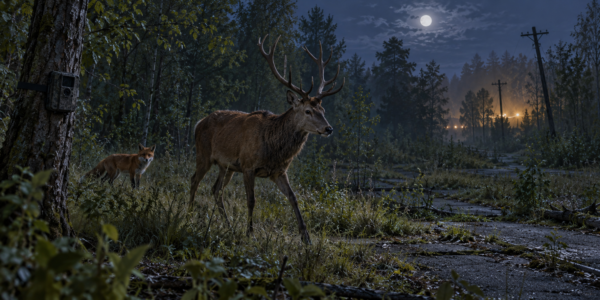
Red deer and red foxes were detected less frequently at night during the occupation than they had been during the corresponding period in 2021. The findings suggest that these animals shifted more of their activity into daylight hours as the conflict intensified.
That might sound counterintuitive until we consider that military movements and operations can continue—or even increase—after dark. Nighttime may no longer have provided the relative safety animals had learned to expect.
Roe deer detections declined overall, while red deer detections increased as conflict activity rose. Wild boar also altered their daily routines.
Brown hares and red deer responded to thermal anomalies, including conflict-related fires, by becoming more active at night.
Rather than producing one common response across the ecosystem, the occupation caused species-specific behavioral changes. Each animal appeared to respond according to its own ecology, sensitivity to disturbance and perception of danger.
Measuring the Intensity of War
To connect wildlife behavior with events on the ground, the research team created a daily conflict-intensity index.
Using interviews—including accounts from nuclear power plant employees—the scientists evaluated military convoys, gunfire, artillery shelling, airstrikes and other disturbances. Each day of the occupation received an intensity rating from zero to ten.
Researchers also considered precipitation, proximity to roads, areas with a permanent human presence and thermal anomalies caused by fires or bombardment.
This allowed them to examine not simply whether animals behaved differently in 2022, but whether their activity changed as the intensity of the conflict increased.
According to the study, mammals showed immediate behavioral adjustments, including reduced nighttime activity and changes on days when armed conflict was more intense.
These behavioral shifts matter. An animal’s daily schedule determines when it can forage, rest, travel, find mates and avoid predators. Even if an animal survives the immediate disturbance, changes to these essential activities can carry longer-term consequences.
What About the Lynx?
The Eurasian lynx is especially interesting because monitoring this elusive wild cat was one of the original reasons the cameras were operating.
Some reports have suggested that lynx appeared unaffected while other mammals changed their behavior. That interpretation needs a little caution.
The researchers documented measurable changes in several more frequently detected mammals, but they did not report the same clear behavioral shift for lynx. That does not necessarily mean the cats felt no effects from the occupation.
Lynx are solitary, wide-ranging and naturally difficult to detect. A relatively small number of camera appearances may not provide enough data to identify subtle changes with statistical confidence.
The most accurate conclusion is that the study found clear changes among several mammal species but did not establish a comparable change in lynx behavior.
Still, the contrast raises compelling questions. Were lynx less affected because of their secretive nature, large territories or ability to avoid disturbed areas? Did they respond in ways the cameras could not capture? Or was there simply too little data to reveal a pattern?
For now, the lynx leave us with a mystery.
From Nuclear Landscape to Militarized Landscape
Chornobyl’s wildlife has often been presented as evidence of nature’s ability to recover when human pressure is removed. The story has never been as simple as animals “thriving because of radiation.” Radiation can harm living organisms. What benefited many of the region’s large mammals was the dramatic reduction in human settlement, agriculture, traffic and hunting.
The invasion introduced human disturbance back into this unusual refuge in its most destructive form.
Military vehicles crossed the landscape. Explosions and fires disrupted habitats. Mines remained after the occupying forces departed. Researchers and conservation workers lost safe access to areas they had been monitoring.
Professor Marco Heurich of the University of Freiburg described the change as a transition away from an ecosystem that had recovered in the absence of people and toward a militarized landscape in which wildlife behavior and habitat use were altered.
War harms far more than the people caught in its path. Its ecological effects can spread silently through forests, wetlands and food webs, changing how animals move through the world long after the immediate fighting ends.
Silent Witnesses in the Forest
Scientists rarely have equipment operating inside a conflict zone before a war begins. Researchers are generally unable to collect systematic wildlife data during active fighting, making the immediate environmental consequences difficult to measure.
The Chornobyl cameras provided an extraordinary exception.
They recorded wildlife before the invasion. They continued recording during the occupation. And they were still there when the soldiers withdrew.
The animals could not tell us what they experienced as military convoys passed and explosions disturbed a landscape that had been largely free of people for decades.
But the cameras kept watching.
Through those silent images, we can see that wildlife did notice. The animals adjusted their movements, changed their hours and responded to the rising intensity of conflict—each species in its own way.
The footage is both a scientific record and a sobering reminder: even in places evacuated by people, war does not enter an empty landscape.
Wild lives are unfolding there, too.
Study: Svitlana Kudrenko et al., “Changes in Wildlife Activity Patterns in Response to War in Ukraine,” Science, 2026. DOI: 10.1126/science.aed1493
Sources: University of Freiburg study summary | Study data and methodology on Dryad | PubMed study record