
Here’s Why According to Science
Spending time with your cat feels so good. The day has been busy. Your mind is still moving through everything you finished, everything you did not finish, and that one conversation you wish had gone differently.
Then your cat settles beside you.
Perhaps a paw rests against your leg. Perhaps a little head nudges your hand. For a moment, the unfinished list can wait.
Many of us recognize that feeling. Spending time with our cats can be one of the most comforting parts of the day. Researchers are exploring what happens during these interactions, and their findings offer some intriguing clues.
The story involves touch, stress responses, and the relationship we share with another living being. It also contains a few surprises.
A little CAT time can change a stress marker
One frequently cited experiment provides evidence that brief contact with animals can affect more than how we say we feel.
In a 2019 randomized controlled trial involving 249 university students, researchers compared four experiences: ten minutes of hands-on interaction with cats and dogs, watching others interact with the animals, viewing animal photographs, or waiting quietly without seeing the animals.
After accounting for factors including baseline cortisol and time awake, students in the hands-on group had lower post-session salivary cortisol than those in the other groups. Cortisol is a hormone involved in the body’s stress response. [1]
The study included both cats and dogs, so it cannot tell us how much of the effect came from cats alone. It also measured a short-term response in students, rather than the lasting effects of living with a cat.
Still, it offers a scientific foothold for a familiar experience: a short break with an animal can help take the edge off a demanding day.
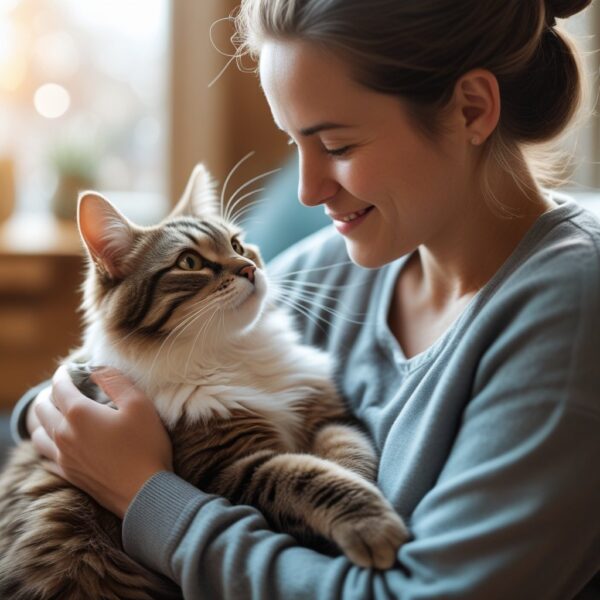
Feeling good does not always mean your body simply slows down
Here is an interesting twist. Time with you cat may be engaging as well as soothing.
A study published in 2023 recruited 32 cat owners in Japan to complete two conditions at home on separate days: interacting with their cats and resting without interaction. The researchers measured emotions, salivary hormones, and heart-related indicators; the usable sample varied by measurement. [2]
During interaction, heart rate increased and one measure of parasympathetic activity decreased. There was no statistically significant overall change in cortisol or oxytocin. The authors suggested that interaction could involve physiological activation, rather than relaxation alone, while emphasizing the small sample and need for further research. [2]
That makes room for a broader picture of of why spending time with your cat feels good. Watching a cat stalk a toy or negotiating who gets the best spot on the sofa may be absorbing, amusing, and lively.
Pleasure does not have to look like complete stillness.
The bond can matter, too
Your cat is someone you know: their routines, their preferences, and the particular way they announce that dinner is running late.
Research also challenges the idea that cats are emotionally detached housemates.
In a 2019 study, investigators used a brief separation-and-reunion test to examine cats’ attachments to their caregivers. Among animals whose behavior could be classified, about two-thirds of both kittens and adult cats were categorized as securely attached. Securely attached cats balanced contact with their caregiver and exploration after reunion. [3]
This research examined the cats’ behavior, rather than whether attachment improved their humans’ mood. But it supports an important part of the picture: the relationship can be meaningful to the cat as well.
A familiar cat choosing to settle beside you can feel like a small moment of connection. That is an interpretation of the everyday experience, rather than a result the attachment study directly measured.
What about the “love hormone”?
Oxytocin often appears in explanations of why cats make us feel good. It is involved in social behavior, but the cat research does not support a simple promise that every cuddle produces an oxytocin boost.
A 2021 study measured salivary oxytocin in 30 women before and after interacting with their own cats, with reading used as a comparison activity. It found no significant overall oxytocin increase attributable to cat interaction. However, changes in oxytocin were associated with particular behaviors, including petting and cats initiating approaches. [4]
Those associations are interesting clues. They do not establish that those behaviors caused the hormone changes, or that the same response occurs in everyone.
Our affection for our cats is easier to recognize than it is to reduce to one chemical explanation.

Everyday rituals give us time with our cats
There is also the ordinary day-to-day life with a cat: the morning greeting, a play session, a companion nearby while you read.
These are possible ways cat companionship becomes comforting in daily life, rather than mechanisms established by the experiments above. A familiar ritual can give us something pleasant to anticipate. Watching a curious little face can bring our attention back to what is happening in front of us.
Sometimes the pleasure is simply having company without needing to find anything to say.
Make sure your cat enjoys the time, too
The nicest cat time leaves room for both participants’ preferences.
In a 2021 study involving 100 shelter cats, people received guidance on giving cats choice and control, noticing their body language, and focusing touch around generally preferred head areas. Following the guidance, interactions included more friendly feline behavior and fewer signs of conflict and aggression. [5]
At home, that means inviting contact and letting your cat decide whether to participate. Offer gentle attention, pause, and see whether they ask for more. If they turn away, become tense, or leave, let the moment end.
For one cat, companionship may mean chin scritches. For another, it may mean sharing the room from a comfortable distance.
A small pleasure worth making time for
The evidence is promising, but it does not show that every interaction lowers stress or that being a cat guardian guarantees better mental health. The studies examine different situations, and several are small.
What they do give us is a more thoughtful appreciation of something cat lovers already value: a relationship made of repeated, ordinary moments.
The next time your cat settles beside you, perhaps you can leave the phone where it is for a little while.
There is a small, warm companion by your side. And that moment of time with your cat deserves your attention.
What is your favorite way to spend time with your cat—playtime, quiet company, or a generous helping of chin scritches? Tell us about your little tiger.
Source
- Pendry, P., & Vandagriff, J. L. (2019). Animal Visitation Program (AVP) Reduces Cortisol Levels of University Students: A Randomized Controlled Trial. AERA Open. https://doi.org/10.1177/2332858419852592
- Effects of Interactions with Cats in Domestic Environment on the Psychological and Physiological State of Their Owners: Associations among Cortisol, Oxytocin, Heart Rate Variability, and Emotions. (2023). Animals, 13(13), 2116. https://pmc.ncbi.nlm.nih.gov/articles/PMC10340037/
- Vitale, K. R., Behnke, A. C., & Udell, M. A. R. (2019). Attachment bonds between domestic cats and humans. Current Biology, 29(18), R864–R865. https://doi.org/10.1016/j.cub.2019.08.036
- Johnson, E. A., Portillo, A., Bennett, N. E., & Gray, P. B. (2021). Exploring women’s oxytocin responses to interactions with their pet cats. PeerJ, 9, e12393. https://doi.org/10.7717/peerj.12393
- Haywood, C., et al. (2021). Providing Humans With Practical, Best Practice Handling Guidelines During Human-Cat Interactions Increases Cats’ Affiliative Behaviour and Reduces Aggression and Signs of Conflict. Frontiers in Veterinary Science, 8, 714143. https://doi.org/10.3389/fvets.2021.714143