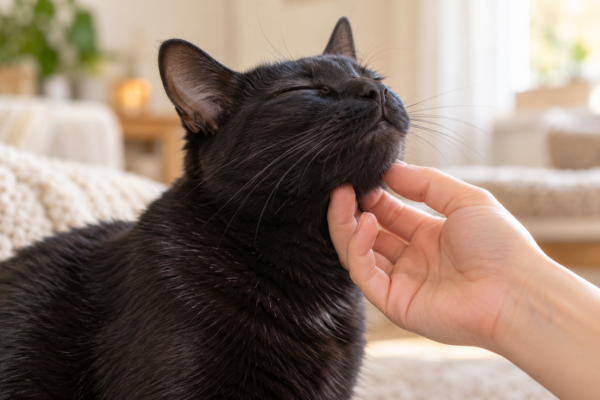
The Science Behind That Little Chin Lift
Bob loves chin scritches. Every single morning he greets me with his head tilted up, his eyes closed and he waits for me to give his little chin gentle scratches.
For many cat lovers, chin scritches are one of the sweetest little rituals we share with our cats. But what makes that spot so appealing?
The answer likely involves pleasant touch, familiar social behavior, and scent communication. Research helps explain the bigger picture, although scientists have not established one definitive reason cats enjoy having their chins scratched.
What the petting research actually tells us
Cats have preferences about where we touch them—and the chin does not win every popularity contest.
In a small 2002 study involving nine cats, researchers found the most positive responses to petting between the eyes and ears. Touch around the chin and lips received intermediate responses. That is a useful reminder that “cats love chin scratches” describes many individual cats, rather than a universal rule. [1]
A later study, published in 2015, also found that location mattered: stroking near the base of the tail produced the greatest negative responses among the areas tested. Neither study establishes exactly why a particular cat loves a particular scritch. [2]
Your own cat still gets the deciding vote.
A familiar kind of friendly contact
Friendly cats sometimes groom one another, a behavior called allogrooming. They also rub against one another, known as allorubbing. These interactions often involve the head and face. [2]
The 2022 AAFP/ISFM Cat Friendly Veterinary Interaction Guidelines note that cats’ preferred touch areas overlap with regions that socially bonded cats groom. This provides a plausible explanation for why gentle attention around the head and chin can be welcome: we are touching areas already involved in friendly feline contact. [3]
That does not prove your cat thinks your fingers are another cat’s tongue. It does suggest that our little scritching ritual fits into a much older feline pattern.
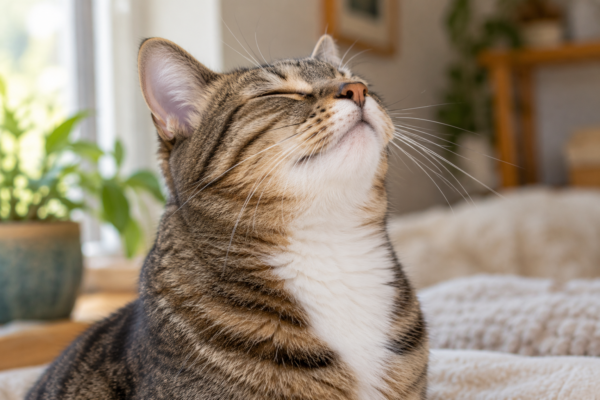
The chin is part of a scent communication system
Cats have scent-producing glands around the face, including beneath the chin. The veterinary guidelines identify these facial gland regions as preferred areas for touch and describe their role in feline chemical communication. [3]
So when a cat rubs their chin or cheek against your hand, scent communication can be part of the interaction.
It is tempting to translate that as, “You belong to me.” A more careful interpretation is that facial rubbing combines physical contact with scent deposition. The presence of scent glands alone does not prove that scratching them releases a special pleasure response—or explain every cat’s enthusiasm.
We can enjoy being chosen without pretending we have translated every word of cat.
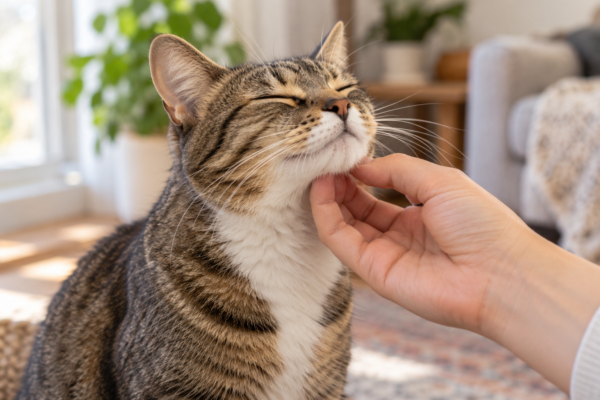
How to offer good chin scritches
Let your cat approach and rub against your hand first. If they welcome contact under the chin, begin with gentle fingertip strokes or small scritches. Keep your hand relaxed and leave them free to move away.
Pause after about three to five seconds. Do they nudge your fingers or move closer? Offer a little more. If they do not renew contact, give them a break. [4]
Watch for a turning head, ears rotating back, a twitching or swishing tail, sudden stillness, or an attempt to leave. These can signal that the interaction should stop. [4]
You do not need to wait for a swat to receive the message.
The best part is letting your cat choose
In a 2021 study involving 100 shelter cats, people were taught to give cats choice and control, watch their body language, and concentrate touch around generally preferred head areas. Cats subsequently showed more friendly behavior and fewer signs of conflict and aggression. This tested an overall approach to interaction, rather than chin scratching alone. [4]
Perhaps that is the nicest lesson behind chin scritches. A small moment of affection becomes more meaningful when we pay attention to the cat enjoying it.
Sometimes the chin lifts again.
Your services are still required.
Does your cat love chin scritches, cheek rubs, or a gentle scratch behind the ears? Tell us where your little tiger likes to be petted.
Sources
- Soennichsen, S., & Chamove, A. S. (2002). Responses of cats to petting by humans. Anthrozoös, 15(3), 258–265. https://doi.org/10.2752/089279302786992577
- Ellis, S. L. H., Thompson, H., Guijarro, C., & Zulch, H. E. (2015). The influence of body region, handler familiarity and order of region handled on the domestic cat’s response to being stroked. Applied Animal Behaviour Science, 173, 60–67. https://doi.org/10.1016/j.applanim.2014.11.002
- Rodan, I., et al. (2022). 2022 AAFP/ISFM Cat Friendly Veterinary Interaction Guidelines: Approach and Handling Techniques. Journal of Feline Medicine and Surgery. https://pmc.ncbi.nlm.nih.gov/articles/PMC10845437/
- Haywood, C., et al. (2021). Providing Humans With Practical, Best Practice Handling Guidelines During Human-Cat Interactions Increases Cats’ Affiliative Behaviour and Reduces Aggression and Signs of Conflict. Frontiers in Veterinary Science, 8, 714143. https://doi.org/10.3389/fvets.2021.714143